
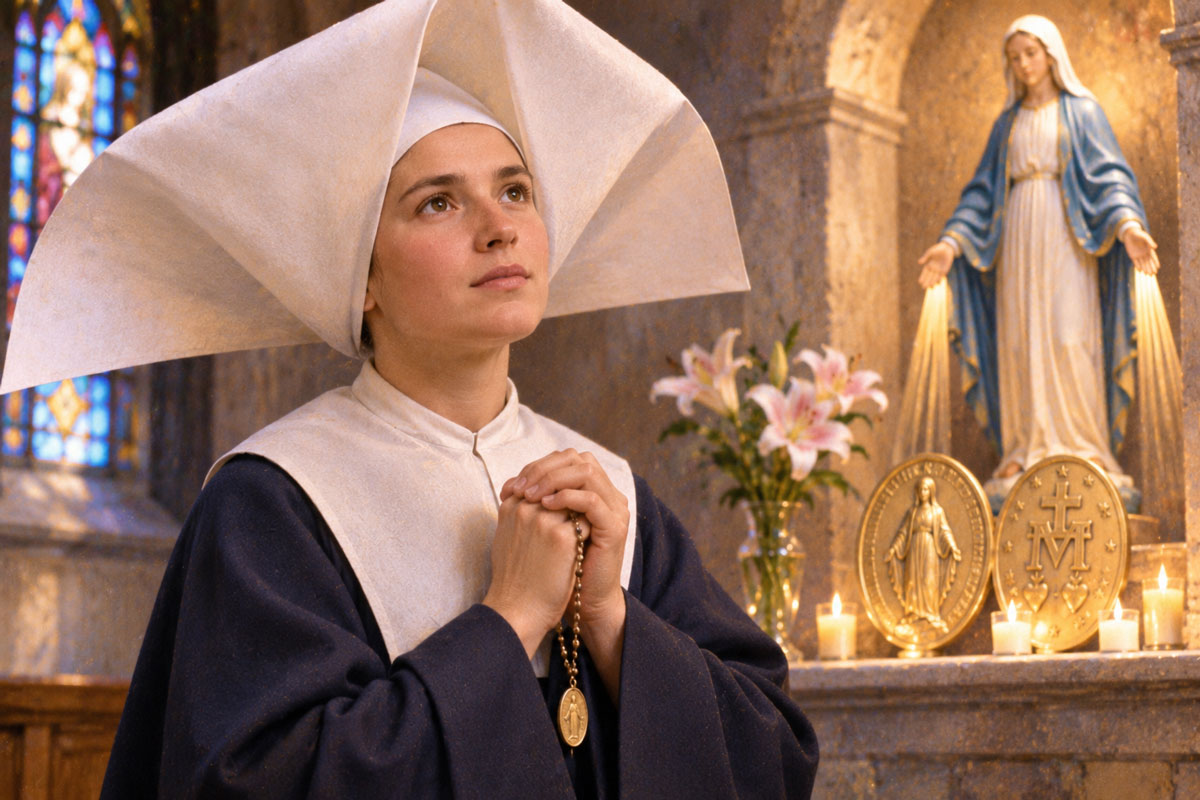
What Is Meant by “God Often Chooses the Humble to Accomplish His Greatest Works”?
“God often chooses the humble to accomplish His greatest works.”
— Inspired by the life of St. Catherine Labouré
“God often chooses the humble to accomplish His greatest works” expresses a beautiful lesson from the life of St. Catherine Labouré. These words remind us that God does not measure greatness by wealth, recognition, or worldly importance. Instead, He often works through those who approach Him with humility, faith, and a willingness to serve. Catherine’s extraordinary spiritual experiences and her quiet life of charity reveal how even the simplest acts of obedience can become part of something far greater than ourselves.
Who Is Associated with “God Often Chooses the Humble to Accomplish His Greatest Works”?
This saying reflects the spiritual witness of St. Catherine Labouré (1806–1876), a French religious sister belonging to the Daughters of Charity of St. Vincent de Paul.
Catherine was born into a farming family in Burgundy, France. Following the death of her mother when she was still a child, she developed a deep devotion to the Blessed Virgin Mary. As a young woman, she felt called to religious life and eventually entered the Daughters of Charity in Paris.
In 1830, while she was a novice at the convent on Rue du Bac, Catherine reported a series of apparitions of the Virgin Mary. During one of these experiences, she described a vision that included the design of a medal bearing an image of Mary and a prayer asking for her intercession.
This became known as the Miraculous Medal, one of the most widely recognized Marian devotional medals in the Catholic Church.
Despite the extraordinary significance later attached to her experiences, Catherine did not seek public recognition. She spent much of her religious life serving elderly and vulnerable people at a hospice in the Reuilly district of Paris.
Her identity as the visionary remained largely unknown to the public during her lifetime, reflecting the quiet humility that became one of the defining characteristics of her spiritual legacy.
What Does “God Often Chooses the Humble” Mean?
These words remind us that humility creates room for God’s grace to work within our lives. When we are willing to place His will above our desire for recognition or control, we become more open to the ways He may guide and use us.
St. Catherine Labouré offers a remarkable example of this spiritual truth. Although her reported visions eventually became associated with a devotion embraced by millions of Catholics, she continued performing ordinary duties within her religious community.
She did not treat her spiritual experiences as a reason to seek importance or special privileges. Instead, she remained dedicated to prayer, obedience, and compassionate service.
Her life reminds us that holiness is not necessarily accompanied by public recognition. Many of the most meaningful acts of faith take place quietly, through responsibilities that may appear insignificant to the world.
The saying also encourages us to recognize that God’s purposes can extend far beyond what we initially understand. Catherine could not have known how widely the Miraculous Medal would eventually spread or how many people would find encouragement through the devotion associated with it.
Her example teaches that we do not need to see the full outcome of our actions before responding faithfully to God’s call.
Why This Quote Still Matters Today
Modern society often measures success through visibility, influence, wealth, and achievement. We may feel that our lives are meaningful only when our accomplishments are recognized by others.
St. Catherine Labouré offers a different understanding of greatness. Her life reminds us that spiritual significance is not determined by public attention, but by faithfulness to God and love for others.
Many opportunities for holiness arise through ordinary responsibilities. Caring for an elderly relative, helping someone in need, offering encouragement, or completing a difficult task with patience can all become expressions of Christian love.
Catherine’s example also teaches us the value of perseverance. Her religious life continued through decades of humble service, long after the extraordinary experiences of her youth.
We may never experience anything resembling Catherine’s reported visions, but we can imitate her humility, prayerfulness, and willingness to serve without expecting recognition.
Her story encourages us to trust that God can accomplish meaningful things through even the quietest and most ordinary lives.
True greatness is not found in being noticed by the world, but in faithfully allowing God’s love to work through us.
If you would like to reflect more deeply on the life and spiritual example of St. Catherine Labouré, you are invited to explore our 30-day devotional,
Walking with St. Catherine Labouré
— a daily journey of prayer, reflection, and spiritual renewal.