
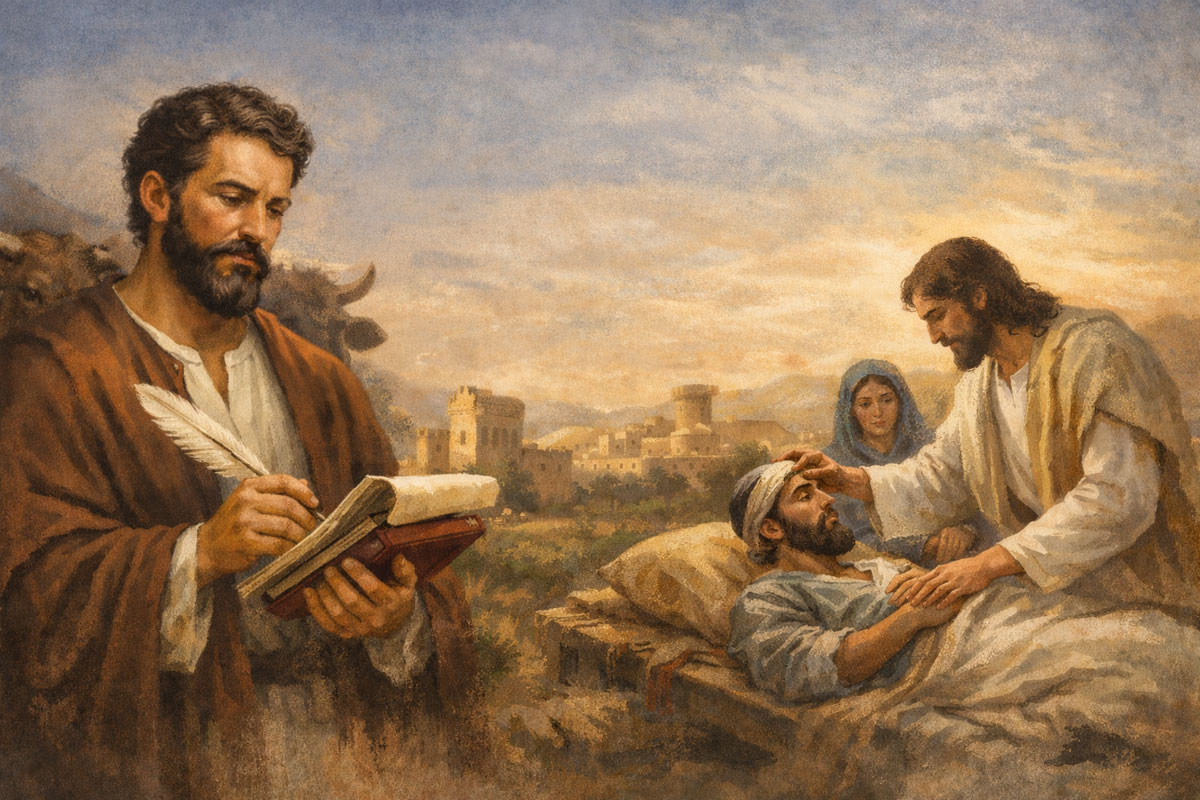
St. Luke the Evangelist was a physician, evangelist, and faithful witness to the life of Christ — a careful observer whose Gospel reveals a Savior rich in mercy and compassion. Writing with attentiveness and tenderness, Luke shows us that God is deeply concerned with the whole human person: body, soul, and spirit. He is now known as a saint of healing, mercy, and Gospel faith — a patron for physicians, artists, and all who seek to see Christ more clearly.
The Healer Who Became a Witness
Luke lived in the first century and is traditionally believed to have been a physician by training. This sensitivity to human suffering shapes his Gospel, which pays special attention to the sick, the poor, and those pushed to the margins of society. Luke was also a close companion of St. Paul, traveling with him on missionary journeys and sharing in the early Church’s hardships and hopes.
Luke did not write as an eyewitness of Christ’s ministry, but as a careful listener. He gathered testimony, reflected prayerfully, and recorded the story of Jesus so that others might come to believe. His Gospel reveals a Christ who stops to heal, listens with patience, and restores dignity to every person He encounters.
“God heals both body and soul.”
Though not a direct quotation, this truth runs through everything Luke records. For him, healing is never rushed and mercy is never withheld. God’s love meets people where they are and draws them gently toward wholeness.
The Gospel of Mercy and Compassion
Luke’s Gospel is often called the Gospel of mercy. It contains beloved passages such as the Good Samaritan, the Prodigal Son, and the healing of the ten lepers — stories that reveal God’s tenderness toward the broken and forgotten. Luke shows us that Christ’s mercy is not reserved for the deserving, but offered freely to all.
More than any other evangelist, Luke highlights women, the poor, and those considered outsiders. He reminds us that no life is unseen and no suffering ignored by God. His writing teaches that faith is lived not only through belief, but through compassion and attention to the needs of others.
Why St. Luke Still Matters Today
In a world marked by busyness, division, and quiet suffering, St. Luke offers a gentle and hopeful witness. He speaks especially to:
- Those seeking healing of body, heart, or spirit
- Caregivers, medical professionals, and healers
- Readers longing to encounter Christ through the Gospel
- Anyone drawn to mercy, compassion, and attentive faith
Luke reminds us that holiness often unfolds through patience, listening, and faithful presence. His Gospel invites us to slow down and notice where God is already at work.
A Faithful Companion of the Early Church
Luke is also the author of the Acts of the Apostles, where he records the growth of the early Church and the missionary journeys of St. Paul. Through Acts, Luke shows how the Holy Spirit continues Christ’s healing work through the Church. His writing reveals a faith that is active, hopeful, and grounded in trust that God guides every step of the journey.
Tradition holds that Luke was also an artist, credited with early Christian icons. Whether through words or images, his life reflects a desire to make Christ known with care and devotion.
Want to Walk with St. Luke?
Ask yourself: Where do I need healing? How might God be inviting me to live with greater compassion? For a deeper journey, you’re welcome to explore our 30-day devotional, Walking with St. Luke the Evangelist, available now. Let St. Luke guide you toward a faith shaped by mercy, attentive love, and trust in God’s healing presence. Because every act of compassion is a step closer to Christ.